Eight companies and four associations representing GMO-free agriculture in Germany have filed an action with the General Court of the European Union in Luxembourg. The action for annulment under Article 263(4) TFEU is directed against the European Parliament and the Council and challenges Regulation (EU) 2026/1388 of 17 June 2026 on plants obtained through “new genomic techniques” (NGTs). On 21 September, the plaintiffs and their lawyers presented the lawsuit at a press conference in Berlin.
What was decided on 17 June
The European Parliament approved the NGT Regulation on 17 June 2026, after the Council of Ministers had already passed it in April. The new regulation was published in the Official Journal of the EU on 26 June 2026 and will apply from 17 July 2028. It exempts a large number of genetically modified plants (those in the NGT‑1 category) from the EU’s GMO requirements. According to the plaintiffs, more than 90% of the plants expected to be produced using new GM techniques will fall into this category.
For these plants, risk assessment, mandatory detection methods, traceability, and national coexistence and opt-out rules will no longer apply. Only seeds and other plant reproductive material will have to be labelled; food and feed produced from them will not.
The plaintiffs point out that the Court of Justice of the European Union ruled as early as 2018 that organisms obtained through new GM techniques are subject to existing EU GMO law (CJEU, Case C‑528/16). In the plaintiffs’ view, the new regulation undermines this principle.
Dispute over national protective rules unresolved
Independently of the lawsuit, it remains unclear what will happen to national coexistence rules that have so far protected GMO-free farms from contamination, including minimum separation distances, registration requirements and liability rules.
A legal opinion by Dr Georg Buchholz, commissioned by the German Association for Food without Genetic Engineering (VLOG), concludes that these rules will continue to apply to NGT‑1 plants because the EU has never comprehensively regulated this area. The German federal ministry of agriculture takes the opposite view, stating that there is no scope for national coexistence measures concerning NGT‑1 plants.
Who is suing and why
The plaintiffs are eight companies and four associations: Dottenfelder Bio-Saat GmbH, BioSaat GmbH, Bingenheimer Saatgut AG, Sonnengut Gerster eGbR, Betzinger OHG, Rapunzel Naturkost GmbH & Co. KG, Rieger-Hofmann GmbH and Rieger Landwirtschafts-eGbR, as well as the Arbeitsgemeinschaft bäuerliche Landwirtschaft (AbL), Die Freien Bäcker – Zeit für Verantwortung e.V., NEULAND – Verein für tiergerechte und umweltschonende Nutztierhaltung e.V., and the Verband deutscher Wildsamen- und Wildpflanzenproduzenten (VWW). The complete list, including contact details, is contained in the press dossier on the lawsuit (in German).
The coalition is represented by Prof. Dr Gerd Winter, an expert in European and environmental law at the University of Bremen; Berlin lawyer Katrin Brockmann, an expert in GMO law; and Hanover lawyer Jens Beismann, an expert in EU plant variety protection law.
The action alleges a range of violations of primary EU law and international law, including:
- freedom to conduct a business
- the right to property
- the principle of equal treatment
- the principles of prevention and precaution, the requirement for a high level of environmental protection, and the polluter-pays principle
- consumer protection requirements
- the Cartagena Protocol on Biosafety
- Article 6 of the Aarhus Convention concerning access to information and access to justice in environmental matters
- the requirements of coherence and justification, and the principle that essential elements must be reserved to the legislature
The plaintiffs are asking the Court to annul the regulation insofar as it exempts NGT‑1 plants and products derived from applicable EU GMO law.
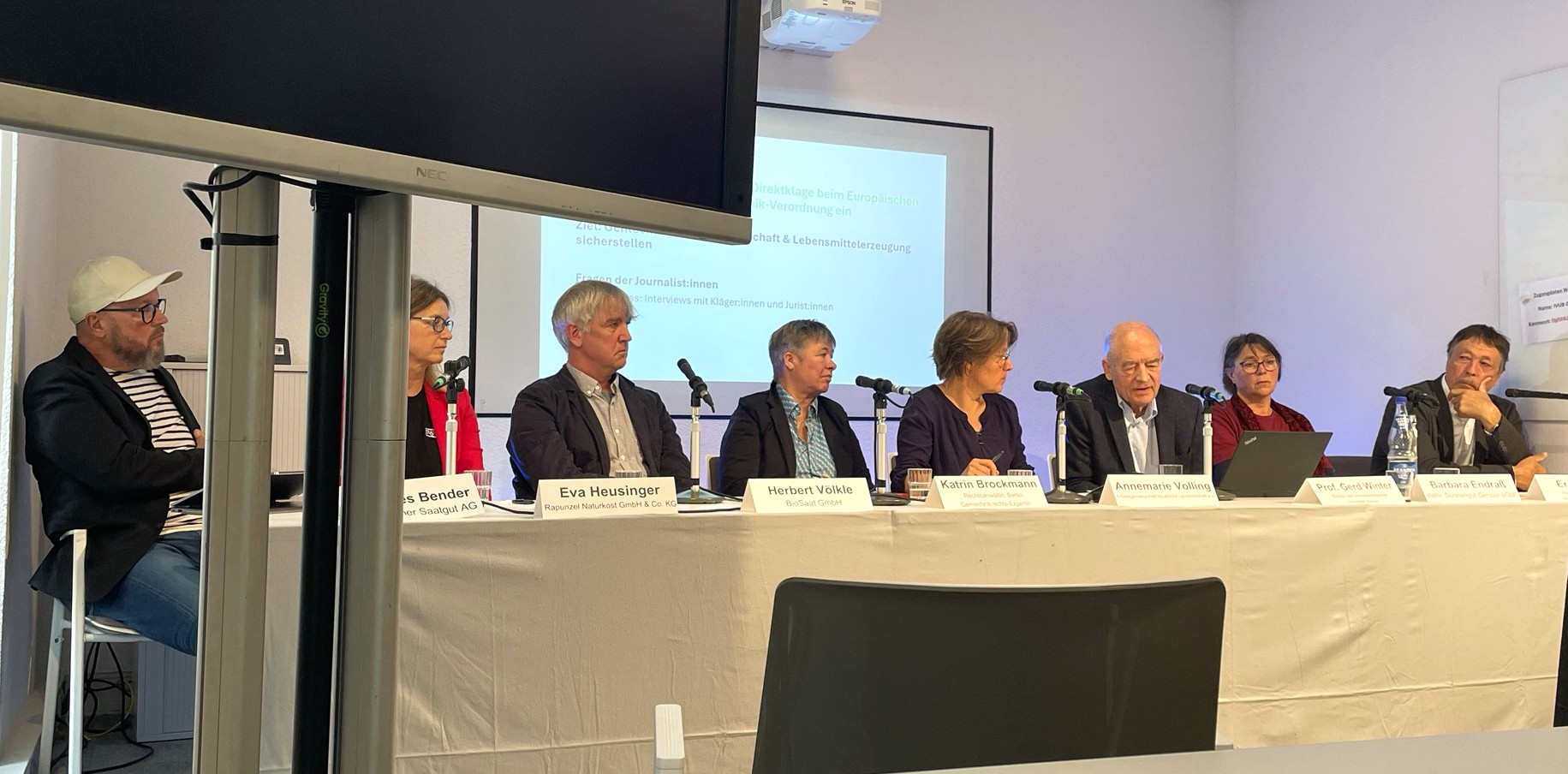
Press conference in Berlin on 21 September 2026
Annemarie Volling, GMO expert at the German Association for Peasant Agriculture (AbL), said the new law would make GMO contamination of seeds, crops and food inevitable. This threatens the economic viability of GMO-free agriculture, which responds to consumer demand for GMO-free products, she argued.
Prof. Dr Gerd Winter of the University of Bremen explained the legal core of the lawsuit: there was no correlation between the number of changes made to genetic material and their actual effects on the plant. In his view, this means that a central premise of the new law rests on shaky ground. Ultimately, he argued, farms would be left to protect themselves against cross-pollination from neighbouring land, creating a burden for the agricultural sector as a whole.
Prof. Winter acknowledged a “significant risk” that the lawsuit could be dismissed because the plaintiffs might lack standing. Under the so-called Plaumann test, plaintiffs must be individually concerned by an EU measure—that is, affected in a way that distinguishes them from everyone else. Prof. Winter said the Court has recently applied this test less strictly. The coalition therefore believes the action is likely to be found admissible.
Herbert Völkle, Managing Director of BioSaat GmbH, explained that seed multiplication was particularly sensitive because even the smallest amount of contamination could have a significant multiplier effect. If GMO-free status could no longer be guaranteed, the resulting reputational damage could threaten BioSaat’s economic existence.
Johannes Bender, Chairman of Bingenheimer Saatgut AG, spoke about organic vegetable, herb and flower seed production, in which predominantly open-pollinated seed is produced in the field rather than in the laboratory. Breeding and seed-production areas are at risk of cross-pollination from neighbouring fields, while customers demand GMO-free products. Without existing transparency and coexistence measures, he said, extensive and costly genome analyses may become necessary, creating a significant additional burden for companies.
Barbara Endraß, a farmer from Wangen, stood in for Sonnengut Gerster eGbR owner Claudia Gerster, who was unable to attend. Endraß described how closely interconnected neighbouring farms are: shared machinery moves between the fields of several farms, continually creating opportunities for contamination. Preventing this, she said, requires transparency about what is being grown and where. She argued that the polluter-pays principle must not be undermined: only those who take responsibility for the consequences have an incentive to deal fairly with their neighbours.
Michael Betzinger, Managing Director of Betzinger OHG, warned: “Contamination could cost us our certification; years of work would be wasted.” He and his brother converted their father’s bakery to artisanal, GMO-free production and operate a regional supply chain, processing grain from a water-protection area into “Waldwasser-Brot” (“Forest Water Bread”). Regional origin and GMO-free production are his most important selling points, he said. Both are threatened by the new regulation.
Eva Heusinger of Rapunzel Naturkost GmbH & Co. KG illustrated how quickly GMO contamination can become an economic risk. She recalled a 2009 case involving Canadian flaxseed contaminated with unauthorised GM flax, saying such a finding could lead to product withdrawals and significant costs for businesses, as well as a loss of consumer confidence.
Finally, Prof Winter pointed to another potential effect of GMO deregulation: an increase in the number of patents, making the propagation of patented seed more difficult. Endraß added that consumers could lose confidence as a result of the new regulation.
Further background information, the complete list of plaintiffs, and the full press dossier can be found on this webpage (in German).