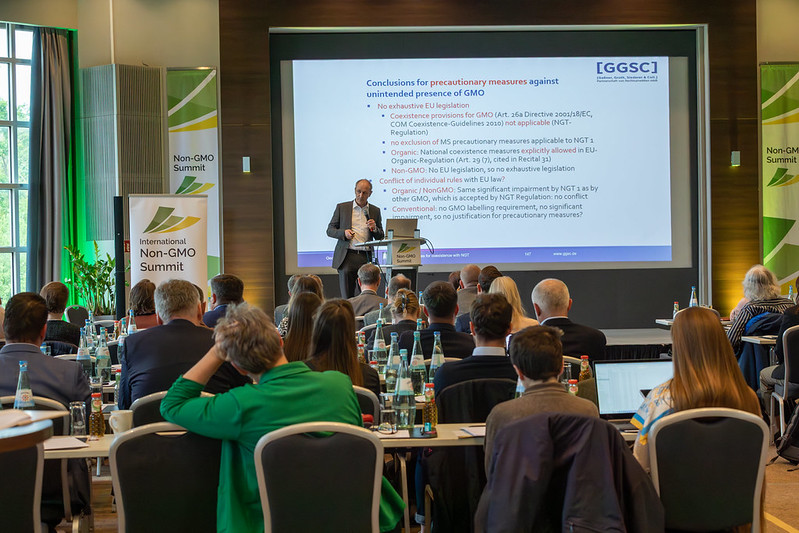
National GMO coexistence rules still apply to all genetically modified (GM) plants, including those deregulated under new EU laws, a new legal opinion shows. This is because the EU has never exhaustively regulated these areas, also not in its latest Regulation (EU) 2006/1388 on plants derived from “new genomic techniques” (NGT). The German federal ministry of agriculture disputes this finding, saying EU regulations leave no room for national rules in this domain.
The legal opinion by Dr Georg Buchholz of GGSC (in German) argues that the EU’s new law governing NGT plants only removes EU-level authorisation and labelling requirements for NGT plants – but not Germany’s national coexistence rules, liability provisions, or site-registration system. Competence over GMO coexistence rules lay, and still lies, with the EU Member States. The opinion was commissioned by the German Association Food without Genetic Engineering (VLOG).
What are GMO coexistence rules?
GMO coexistence rules are measures that protect those who farm GMO-free, as well as nature reserves, from GMO contamination. In Germany, this includes an obligation to notify neighbours, to maintain minimum distances between fields, a public register of GMO planting sites, and liability if contamination happens. Further rules apply at a regional level. In Bavaria and Hesse, for example, the cultivation of GM plants is prohibited throughout their entire territories.
Such rules are set at national level, according to the EU’s GMO regime that expressly allows Member States to take measures to prevent the unintended presence of GMOs in other crops. The European Commission merely collects relevant information and develops guidelines on the coexistence of genetically modified, conventional and organic crops. According to the latest guidelines issued in 2010, matters relating to financial compensation or liability for economic damage fall within the exclusive competence of the Member States.
Why would national rules not apply?
The EU has just passed a new regulation, published as Regulation (EU) 2006/1388, that excludes GM plants with no more than 20 genetic changes “per monoploid genome” from EU requirements such as risk assessment, supply chain traceability and consumer labelling. These GM plants fall under a new category of plants termed “NGT Category 1” or NGT1. According to the European Commission, the modifications introduced in these plants “could also occur naturally or be obtained by conventional breeding”. The new rules will apply from 17 July 2028.
In response to the new legal opinion, Germany’s federal ministry of agriculture has said the new EU regulation leaves no room for national rules on GMO coexistence or liability. The ministry claims the European Commission is of the same view. A spokesperson told Tagesspiegel Background: “According to the legal view of the Federal Ministry of Agriculture, Food and Regional Identity and of the European Commission, there is no scope for national coexistence measures with regard to category 1 NGT plants.”
New EU NGT law does not preclude national measures
The legal opinion states, however, that national protective measures relating to the cultivation of GM crops continue to apply to NGT1 plants as well, even after the EU’s new regulations take effect.
According to expert lawyer Dr Georg Buchholz, the new EU NGT regulation does not affect these rules, neither excluding nor prohibiting them in any way. He argues that the regulation expressly lifts the application of EU-level GMO rules to NGT1 plants and their products – but does not preclude the application of national-level GMO rules such as GMO coexistence rules or nature conservation laws.
Support in principle from Minister Rainer
In May, Agriculture minister Alois Rainer had reassured the sector that GMO-free production will remain possible even after the EU’s new NGT law enters into force. He told the Non-GMO Summit in Frankfurt: “I am convinced that we can enable innovation without compromising the high labelling and traceability standards for non-GMO products.”
Alexander Hissting, director at the German Association Food without Genetic Engineering (VLOG), believes however that Germany’s non-GMO standards “depend on the existing protection rules remaining in place”. He called on the federal ministry of agriculture to ensure that national coexistence rules are applied to all GMOs, including NGT1 plants.
National protections more important than ever
For farms producing GMO-free dairy, eggs, or meat, national coexistence rules are of critical importance: without the obligation to pass on reliable information along the supply chain, they may no longer be able to know whether the feed they use contains NGT1 crops. Existing protections should therefore continue to be applied.
“The new EU law was always designed to undermine food transparency and make GMOs invisible in order to circumvent public opposition. But the explicit recognition that all GMOs remain banned in organic production means that these plants – even if hidden from consumers – must remain visible in the field. Ensuring this is the responsibility of national and regional governments, and they cannot evade that responsibility,” said Franziska Achterberg, Head of Policy at Save Our Seeds.
Save Our Seeds calls on all EU governments to enforce and strengthen their national GMO coexistence rules to protect GMO-free producers and nature protected areas against any GMO contamination, including contamination with NGT1 plants.
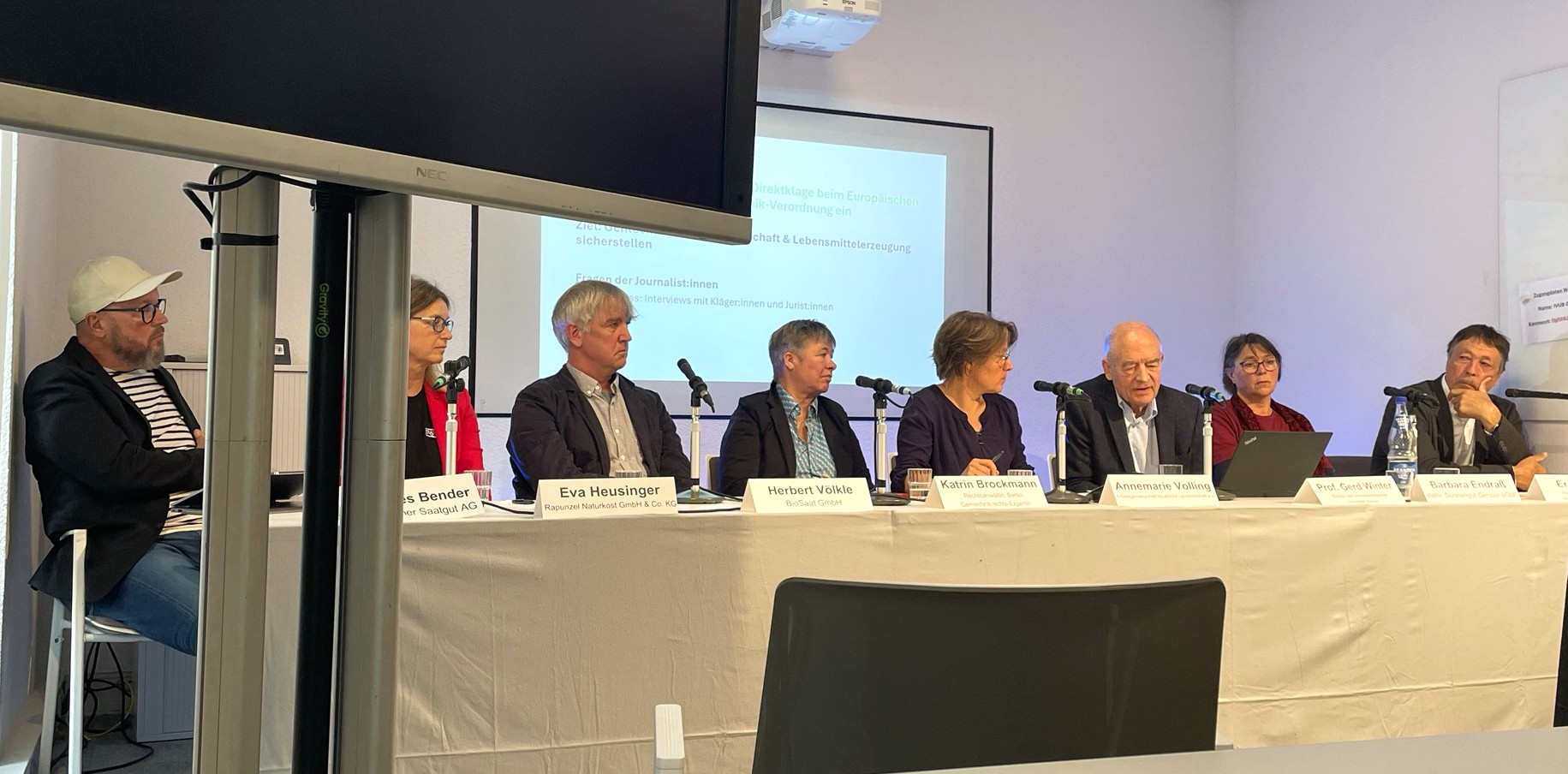
Image © Nina Werth. Georg Buchholz presents to the Non-GMO Summit in Frankfurt, 13 May 2026.