
A genetically modified microorganism engineered to outcompete natural mouth bacteria
- A super-competing genetically modified bacteria designed to permanently colonise the human mouth is currently available for sale in the United States and Honduras.
- The modified strain continuously produces ethanol — a known carcinogen — in place of the lactic acid it would naturally produce.
- Spreading of the genetically modified bacteria (GM) between people, including infants, is highly likely based on established transmission pathways for this bacterial species.
- Advances in AI-assisted biological design could greatly compress development times for self-spreading super-competing genetically modified microorganisms capable of permanent establishment in natural microbial communities (microbiomes).
- The producer of this high-risk GM microbe has taken great lengths to avoid scrutiny by regulatory authorities.
What is the issue?
BCS3-L1 is a genetically modified strain of a bacterium called Streptococcus mutans, developed as a one-time treatment to permanently prevent tooth decay. The strain was engineered to incorporate a gene from another bacterial species, enabling it to produce ethanol instead of the lactic acid naturally generated by this species — which is the primary acid responsible for cavity formation [1].
In addition to its genetically altered metabolic pathway, BCS3-L1 was isolated to be a ‘super-competitor’ with the capacity to outcompete other bacteria in the oral microbiome through the production of a naturally occurring antibiotic (mutacin). The product is intended as a single topical application that permanently replaces a consumers’ native oral bacteria with the modified strain and is currently priced at USD 250 [2].
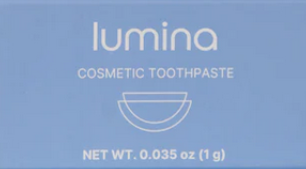
Front of the toothpaste package containing genetically modified bacteria, Source: Lumina
Commercialisation was first attempted by Oragenics, Inc. in the early 2000s. This included two applications for Phase I clinical trials under the supervision of the USA Food and Drug Administration (FDA). However, direct commercialisation was ultimately abandoned by Oragenics prior to 2015 [3]. In 2023, Lantern Bioworks acquired the rights and began marketing the organism as ‘Lumina Probiotic’, repositioned as a cosmetic product rather than a drug [4]. The product’s initial commercial launch reportedly took place in Próspera, Honduras — a private charter city with minimal regulatory oversight [4]. According to the original developer and the current producer, colonisation of the human mouth with the modified microbe persists for more than 20 years [2].
Why does this matter?
Self-spreading ‘super-competitor’
The engineered strain’s enhanced colonisation capabilities, combined with its native antibiotic production that eliminates competing bacteria, could facilitate even more efficient spread than most wild-type strains.
It is well established that mother-to-child transmission of unmodified S. mutans occurs at extremely high rates, with studies demonstrating that virtually all children acquire their oral S. mutans strains from their mothers through routine contact such as kissing and shared utensils [5, 6, 7]. Substantial transmission of unmodified S. mutans between household members is also very well documented [8, 9]. The magnitude of the transmission concern (see also next section) led the FDA to impose significant but proportionate conditions on the Phase 1a clinical [10, 11]. Having reviewed the results of the first trials, for a subsequent phase 1b trial, the FDA demanded “a plan to eradicate the modified organism in subjects’ children, along with mandatory pregnancy testing for partners of subjects” [12]. The Phase 1b trial was never conducted [12], and Phase 1a data are not generally public.
Continuous carcinogenic ethanol production
A fundamental safety concern stems from BCS3-L1’s continuous ethanol production directly within the mouth. Ethanol has been classified as a Group 1 carcinogen by the International Agency for Research on Cancer (IARC), with specific evidence linking it to oral cavity cancers [13]. While the quantity of ethanol produced by the bacteria would be small compared with that from consuming alcoholic beverages, the continuous and permanent nature of this novel exposure is likely to be the reason for the FDA clinical trial restrictions mentioned above (see also [14]). Despite obvious concerns, shared by competent regulators, there is no public human data available on the risks associated with BCS3-L1 as a novel, continuous source of ethanol production in the mouth (see also [15]).
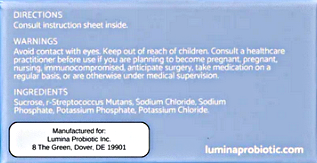
Back of the toothpaste package containing genetically modified bacteria, Source: Lumina
What might be the consequences?
The history of Lumina Probiotic shows that certain companies [16] are ready to go a long way to exploit weaknesses in regulatory frameworks for genetically modified microbes. Consequently, a self-spreading and super-competing genetically modified organism has been released into the environment without adequate safety assessment.
Despite being sold as a “cosmetic”, the product carries a prominent warning on its packaging:
“Consult a healthcare practitioner before use if you are planning to become pregnant, pregnant, nursing, immunocompromised, anticipate surgery, take medication on a regular basis, or are otherwise under medical supervision.”[17]
While the development of BCS3-L1 spanned more than 20 years, advances in AI-assisted biological design will greatly compress the development timeline for similar super-competing genetically modified microorganisms [18,19]. The regulatory gaps ex-posed by this case highlight the pressing need for safety regulations that effectively protect both the environment and the society at large.
Key References
[1] Hillman, J.D., Mo, J., McDonell, E., Cvitkovitch, D. and Hillman, C.H. (2007). Modification of an effector strain for replacement therapy of dental caries to enable clinical safety trials. Journal of Applied Microbiology, 102(5), pp. 1209–1219.
Lantern Bioworks (2023). Lumina Probiotic product information. https://luminaprobiotic.com. As of approximately 5 May 2026, this website became unavailable; the reasons are currently unknown, and it is unclear whether this is temporary. We therefore suggest using this archived version from 2 March 2026 until the status of the product is resolved: . It is worth noting that this product was reportedly on sale in Honduras before a website existed, and may continue to be available through the similar channels. (Accessed 15 March 2026).
[3] Oragenics, Inc. (2023). Oragenics enters into agreement with Lantern Bioworks for replacement-therapy assets and retains ten percent royalty. (Accessed 30 March 2026).
[4] Szalinski, C. (2024). Brushing with bacteria: The debate over a GMO tooth microbe. Undark Magazine, 17 April. (Accessed 15 March 2026).
[5] Berkowitz, R.J. (2006). Mutans streptococci: acquisition and transmission. Pediatric Dentistry, 28(2), pp. 106–109.
[6] Caufield, P.W., Cutter, G.R. and Dasanayake, A.P. (1993). Initial acquisition of mutans streptococci by infants: evidence for a discrete window of infectivity. Journal of Dental Research, 72(1), pp. 37–45.
[7] Li, Y. and Caufield, P.W. (1995). The fidelity of initial acquisition of mutans streptococci by infants from their mothers. Journal of Dental Research, 74(2), pp. 681–685.
[8] Mattos-Graner, R.O., Li, Y., Caufield, P.W., Duncan, M. and Smith, D.J. (2001). Genotypic diversity of mutans streptococci in Brazilian nursery children. Journal of Clinical Microbiology, 39(8), pp. 2929–2934.
[9] Klein, M.I., Florio, F.M., Pereira, A.C., Hofling, J.F. and Gonçalves, R.B. (2004). Longitudinal study of transmission, diversity, and stability of Streptococcus mutans genotypes in Brazilian nursery children. Journal of Clinical Microbiology, 42(10), pp. 4620–4626.
[10] Oragenics, Inc. (2005). Annual Report (Form 10‑K). United States Securities and Exchange Commission.
[11] The FDA conditions for the Phase 1a trial that included engineering a ‘recall mechanism to completely eradicate the organism from human subjects’ and that the trial subjects be quarantined to a hospital-type setting [10].
[12] Oragenics, Inc. (2006). Annual Report (Form 10‑K). United States Securities and Exchange Commission.
[13 International Agency for Research on Cancer (IARC) (2010). Alcohol consumption and ethyl carbamate. IARC Monographs on the Evaluation of Carcinogenic Risks to Humans, Vol. 96. Lyon, France: IARC.
[14] Smędra, A. and Berent, J. (2023). The influence of the oral microbiome on oral cancer: a literature review and a new approach. Biomolecules, 13(5), 815.
[15] It may also be noted that S. mutans is associated with, or causal in, a significant number of the approximately 5,000 annual deaths in the EU due to infectious endocarditis — a condition in which mouth-associated bacteria attack the heart (see Streptococcal endocarditis: a meta-analysis of species dependant risk, eClinicalMedicine*, 2025), “Hillman’s team must rigorously prove the safety of its strain, warns Robert E. Marquis of the University of Rochester (N.Y.) Medical Center, who has also looked into S. mutans replacement therapy. On rare occasions, he notes, the natural microbe escapes into the blood and causes dangerous heart infections. Hillman’s group has indeed begun to check whether its replacement strain is more or less likely to do the same.” Hillman was the original developer of this product.
[16] Alexander, S. (2026). Defying cavity: Lantern Bioworks FAQ. Astral Codex Ten, 16 January. Available from: (Accessed 30 March 2026).[17] The duplication of the word “pregnant” appears to be a mistake on the for-sale packaging (see picture on briefing first page).
[17] The duplication of the word “pregnant” appears to be a mistake on the for-sale packaging (see picture on front page).
[18] Nguyen, Eric, Michael Poli, Matthew G. Durrant, et al. 2024. ‘Sequence Modeling and Design from Molecular to Genome Scale with Evo’. Science 386 (6723): eado9336.
[19] Koblitz, Julia, Lorenz Christian Reimer, Rüdiger Pukall, and Jörg Overmann. 2025. ‘Predicting Bacterial Phenotypic Traits through Improved Machine Learning Using High-Quality, Curated Datasets’. Communications Biology 8 (1): 897.
Any non– factual opinions expressed in this publication do not necessarily reflect those of the organisation SOS.