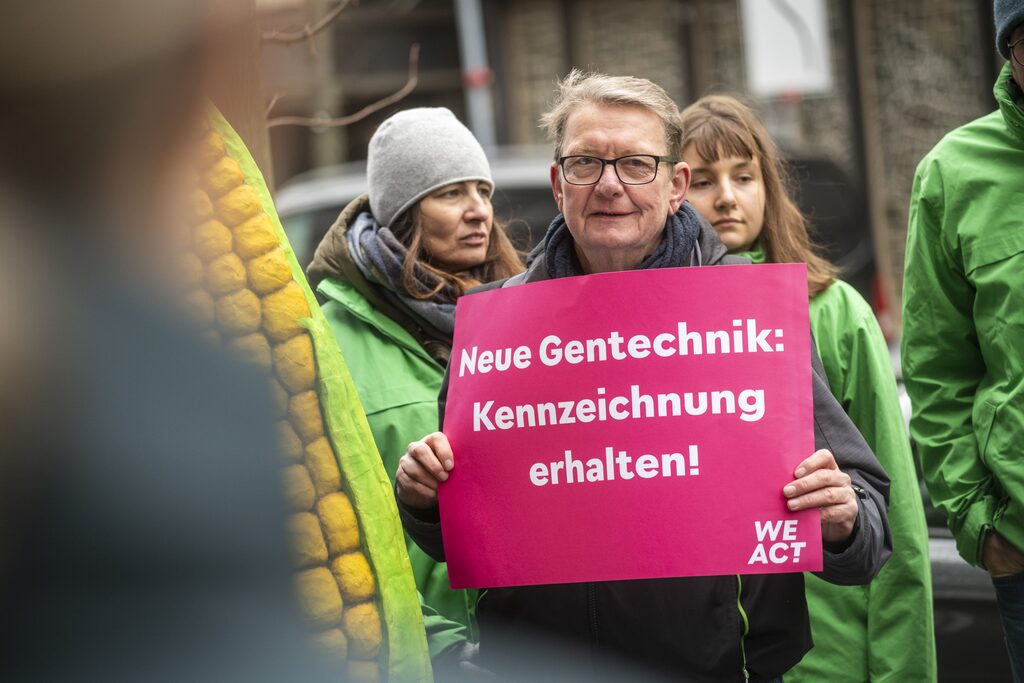
In the night of 3 to 4 December, negotiators from the EU Parliament, Council of Ministers and Commission reached an agreement on a far-reaching deregulation of plants engineered with new GM techniques such as CRISPR/Cas. Under the deal, almost all requirements of EU GMO legislation would be abolished for this type of GM plants.
What was negotiated?
Genetically modified (GM) plants that meet the criteria of the so-called “NGT Category 1” are to be placed on the market without consumer labelling, traceability, or risk assessment. This category covers GM plants in which fewer than 20 changes “per monoploid genome” have been made. The organisation Testbiotech says these criteria „make no sense from a scientific perspective”. They only serve to “exempt the vast majority of NGT plants from the current EU GMO regulation.“
For these GM plants, manufacturers would no longer have to provide any analytical detection methods. Requirements for environmental monitoring would also be scrapped. The official explanation is that these GM plants are broadly the same as conventionally bred plants. Nevertheless, patent law will continue to apply – regardless of whether these GM plants are “comparable to conventionally bred plants” or not.
In the EU negotiations, the Council and the Commission ultimately pushed through their positions, while the Parliament offered little resistance. This was despite the fact that the Parliament had previously voted in favour of consumer labelling for products derived from NGT1 plants and for a ban on patents covering traits and plants that “could have been produced through conventional plant breeding.” For Jan Plagge, President of IFOAM Organics Europe, it was “difficult to understand how Parliament’s negotiators could simply back away from the European Parliament’s clear demands to protect European SMEs and food sovereignty.”
What is new in the EU deal is that GM plants would only be classified as “NGT1” if the genetic modification is not intended to make them herbicide-tolerant or cause them to produce a “known insecticidal substance”. Initially, the Council – driven by France – wanted only herbicide-tolerant GM plants to be excluded.
Consumers to be kept in the dark
Under the EU deal, only NGT1 seed would still have to be labelled, while final food products would not. This runs directly counter to the interests of consumers in Germany. According to a survey by the Federal Agency for Nature Conservation (BfN), 94 percent of adults want foods produced using new GM techniques to be clearly labelled at the point of sale.
The Federation of German Consumer Organisations (VZBV) confirms this: “Surveys show—and we also see this in our counselling work—that this is important to many people.” The food retailer Rewe therefore views the decision “critically” and wants to examine “possible impacts.” The company emphasized: “In the interests of our customers, we advocate freedom of choice and transparency along the entire value chain.” Rewe is the second-largest food retailer in Germany after Edeka.
No restriction on patenting
On the issue of patents, negotiators sought to improve legal certainty for breeders and farmers with a few minimal safeguards. An expert group is to monitor developments, and the European Commission is to develop a code of conduct for licensing.
The German Farmers’ Association (DBV), generally a supporter of new GM techniques, sees “a clear red line being crossed” when it comes to patents. It warned: “If key plant traits are monopolised by individual companies, our farmers and small and medium-sized breeders will lose access to important genetic material.” The consequences for agriculture could be far-reaching: “Less competition among breeders, rising seed prices, and a decline in varieties’ diversity.”
A coalition bringing together the German Farmers’ Association (DBV), the Federal Association of German Plant Breeders (BDP), the Federation of the Organic Food Industry (BÖLW), and others had called for an effective restriction of patents.
Organic and non-GMO sectors bear the costs
In organic farming, the use of GM plants – including so-called NGT1 plants – remains prohibited. However, if traces are “technically unavoidable” in organic products, this does “not constitute non-compliance”. The German Federation of the Organic Food Industry (BÖLW) stresses: “Organic remains safe.” It lambasted what it described as a “sell-out of European plant breeding and agriculture to corporate interests,” to the detriment of the European food sector.
The Association for Food without Genetic Engineering (VLOG) points out that meeting consumer demand for food without genetic engineering would become significantly more burdensome, “making food even more expensive.” It also argues that abolishing labelling requirements would “harm the entire European food sector, not just the ‘without genetic engineering’ and organic segments.”
Organic farmer Pola Krenkel from Bavaria fears: “If this proposal goes through as it stands, the future of GMO-free agriculture and the environment is at stake. We risk the full patenting of our basic resources. Farmers and breeders would have to deal with complicated patent issues and legal disputes—an absolute nightmare.”
German government wavering
For the new law to take effect, the agreement must still be approved by a majority in both EU Parliament and Council. In Parliament, the rapporteur is unlikely to win a majority without the help of the far right. Many Socialists want stricter rules, as do the Greens and the Left. Most political groups are split on the issue, the outcome is therefore hard to predict.
In the Council, a majority could also be narrow. In March, the previous German government did not support the proposed GMO deregulation. How the current government will act remains unclear. A spokesperson for the Federal Ministry of Agriculture referred Süddeutsche Zeitung to the coalition agreement, which states the intention to “promote biotechnology as a key technology and facilitate its application through regulation, including with regard to new genomic techniques.”
In Germany and across Europe, environmental organisations, consumer protection groups, and organisations representing the organic sector and small-scale farmers are united in opposing GMO deregulation. More than 500,000 citizens are calling for existing rules to be maintained, including for new GM techniques such as the CRISPR/Cas “gene scissors.”
Save Our Seeds Save Our Seeds also took part in a joint protest in front of the German Chancellery.
Bild © Nick Jaussi. Benedikt Haerlin at the handover of a GMO petition to the German Ministry of Agriculture on 26 November 2025.