
A self-replicating chromosome cutting system, approved by one exporting country, potentially deciding exposure for citizens in importing countries.
Key Facts
→ BiomElix One is a living, self-replicating product. It’s a chicken feed additive made of live, genetically engineered bacteria, fed to chickens (approved for use only in Brazil) to reduce Salmonella contamination.
→ It works by transferring engineered DNA far beyond its target Salmonella species. The transfer isn’t targeted to a single bacterial species — it happens through direct contact and passes into any susceptible bacteria, not just its intended target species.
→ Creating new genetically modified bacteria in the gut is the mechanism, not a side effect. Every transfer creates, by definition, a new genetically modified organism. Unlike a single, controlled event in a laboratory, this happens millions of times, in an uncontrolled manner, inside animal guts.
→ BiomElix One generates living modified bacteria inside animal guts — and those organisms could potentially remain in chicken meat for sale. Because genetically modified bacteria are living, self-replicating organisms, any importing country that chooses not to carry out its own regulatory risk assessment can end up exposing its own citizens — quietly bypassing any relevant regulations it may have.
What is the issue?
Salmonella is a bacteria well known for causing food poisoning in humans, but it also slows the growth of birds in commercial chicken farms. In response to the growth issue, two approaches to Salmonella control have emerged: the first improves the conditions in which chickens are raised and has been the successful basis of EU policy since 2003[1]. The second uses anti-Salmonella feed supplements and is particularly prevalent in the highly intensive farming systems of the Americas. BiomElix One is a first-of-its-kind feed additive that is an example of the latter approach. It works by loading into bacteria CRISPR gene-cutting instructions that are located on circular bits of replicating DNA called plasmids. These plasmids are then actively spread through the bacterial communities naturally living in chicken’s guts — passing them from bacterial cell to cell, across the many different bacterial species living there[3]. Where these engineered plasmids enter Salmonella bacteria, they cut their chromosomal DNA and kill it. In every other species the plasmid transfers to, the same introduced DNA cutting mechanism remains active, but it is not expected to be effective in actually cutting chromosomes — however, each plasmid transfer itself still creates a new, living genetically modified organism.
Cross-species spread as an intended design feature
This spread across species isn’t a side effect. It’s how the product is designed to work: to reach Salmonella, the instructions must pass into many, or even most, of the bacterial species in the gut. So, producing large numbers of different genetically modified bacteria, across many species, is core to the mechanism by which this product is intended to work. BiomElix One is built from genetic elements known to work between bacteria that are separated by many hundreds of millions of years of evolutionary distance.
Key safety data not made public
Once the engineered plasmid is established in the gut bacterial community, it will not remain inside the bird, but will disperse into the environment through droppings and potentially slaughter waste (see Figure). Furthermore, raw poultry meat is documented to carry live bacteria through to the point of sale [4] — though remarkably, nobody appears to have publicly tested whether any of those bacteria would carry the plasmid released by BiomElix One. It should be noted that most key safety properties of BiomElix One are not public due to regulatory documents being treated as confidential business information, this is despite its commercial approval. [5]
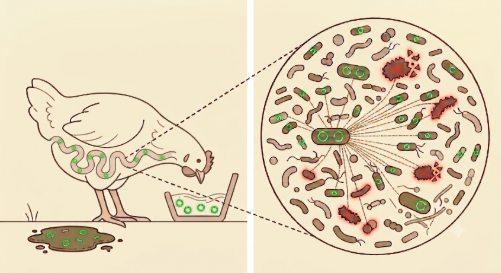
How BiomElix One generates new, living, genetically modified bacteria in chicken guts. Chickens drink water with the delivery bacteria that contain the engineered plasmids (green circles). Inside the gut, the delivery bacteria continue to make copies and transfer the plasmid to many bacterial species[3] — most simply retain the plasmid (non-target species) — while a small proportion are killed (the target Salmonella species, shown bursting). Bacteria carrying engineered plasmids become dispersed into the environment through the chicken’s droppings, and other routes.
Box. Obvious vertebrate concerns left unaddressed. Gut bacteria generally live freely in vertebrate digestive systems, but some also have the ability to invade inside the cells of vertebrates [10]. Medical students learn the acronym LISTEN to remember bacteria that can invade and live inside human cells — Listeria, Intracellular (not a genus — just a placeholder reminder word), Salmonella, Tuberculosis (for genus Mycobacterium), Enterocolitica (for genus Yersinia enterocolitica), Neisseria. Every one of these is named in the patent describing BiomElix One as targetable by the plasmid transfer, [11] and four of the five are also reported in chicken guts. [12] The 2008 paper that first described the broad-spectrum horizontal gene transfer technique BiomElix One is based upon noted it was “especially suitable for use inside eukaryotic cells” — and all human cells are eukaryotic. [13] If eating meat from a treated bird may mean consuming bacteria carrying active, engineered gene-cutting molecules, [14] some of these bacteria are capable of entering human cells — bringing synthetic chromosome-cutting molecules into close proximity to the human genome — closer than they would normally come outside a controlled medical laboratory. [15]
Why does this matter?
A double standard: approved for the environment, barred from the clinic
Scientists have had a name for what BiomElix One does long before it existed as a commercial product: broad-spectrum horizontal gene transfer [6]. In 2018, the National Academies of Sciences, Engineering, and Medicine — in an assessment commissioned by the U.S. Department of Defense — rated the difficulty of detecting or stopping this kind of intervention, once released, as medium-high risk: one of the most serious ratings the report gives to any potential hazard it assessed. [7] Yet within six years, this same category of technique had been approved for commercial use in animals raised for human food in one major meat-exporting country — while, at the same time, no country on Earth has approved it even for use in controlled clinical trials in humans, despite obvious potential applications (see Box). [8]
What might the consequences be?
When one country’s approval decides risk for others
Countries usually protect their own citizens by setting their own rules — inspecting imports and if necessary declining products *.
This kind of oversight, in theory, can work well for chemicals or parts of crop plants, but works less well for living, self-replicating organisms (or self-replicating modified plasmids) that can potentially persist in traded products or in the wider environment. With microbes, exporting countries with the highest tolerance for risk or the weakest oversight can decide for all those countries that import potentially contaminated products. This is a concerning and largely new kind of loophole, specific to living genetically modified microbes — because an approval in one country can ultimately put such products on the plates of people in another country if their government chooses not to properly apply its own regulations.
* From September 3, 2026, Brazilian meat — including chicken — has been barred from entering the EU, under a measure targeting compliance with EU rules restricting antimicrobial (antibiotic) use in food-producing animals.[9] Antibiotic-resistance genes are commonly carried on the same broad-host-range plasmids exploited in BiomElix One.
Key References
1. European Parliament and Council, Regulation (EC) No 2160/2003 of 17 November 2003 on the control of salmonella and other specified food-borne zoonotic agents.
2. Folium Science, a UK company, developed and manufactured BiomElix One as part of what it termed its “Guided Biotics®” platform. On 25 August 2026, US company BiomEdit announced it had acquired Folium Science’s technology platform and pipeline assets, explicitly highlighting BiomElix One’s existing regulatory access to the Brazilian market as part of the deal’s value (https://biomedit.com/biomedit-acquires-folium-science-technology-and-pipeline-assets-to-expand-programmable-veterinary-biologics-capabilities/). BiomEdit’s own lead product uses a different mechanism: it engineers gut bacteria (Lactobacillus reuteri) to express llama-derived antibodies (“nanobodies”) that neutralize toxins from a chicken pathogen (Clostridium perfringens) — an approach that, unlike BiomElix One, does not involve engineered genes transferring between bacterial species. A May 2026 cached version of the foliumscience.com website giving some product details is available from http://web.archive.org/web/20250825073906/https:/foliumscience.com/
3. Conjugation is a natural process by which bacteria transfer DNA — typically a plasmid — directly from one cell to another through physical contact via a structure called a pilus. It is one of three known routes of horizontal gene transfer (alongside transformation and transduction) and does not require donor and recipient to be closely related; broad-host-range plasmids like those used in BiomElix One are specifically capable of transferring between very distantly related bacterial species.
4. European Food Safety Authority & European Centre for Disease Prevention and Control (2025), The European Union One Health 2024 Zoonoses Report, EFSA Journal.
5. CTNBio Technical Opinion No. 7098/2020 — the official Brazilian regulatory dossier describing BiomElix’s mechanism, composition, and approval basis.
6. “Horizontal” means between unrelated organisms — commonly in bacteria between very distantly related species; “vertical” means passed down from parent to daughter cells.
7. National Academies of Sciences, Engineering, and Medicine (2018), Biodefense in the Age of Synthetic Biology, Washington, DC: The National Academies Press. Note this is primarily a biosecurity report and not focused on consumer biosafety.
8. Standard human clinical trial protocol requires informed consent from participants and built-in mechanisms to pause or stop the trial if adverse effects appear. One company pursuing a comparable approach has so far been unable to obtain permission to conduct such trials: https://www.sniprbiome.com/our-approach-and-technology
9. European Commission, Commission Implementing Regulation (EU) 2026/1189 (5 June 2026), removing Brazil from the list of third countries authorised to export animal products under Regulation (EU) 2021/405, effective 3 September 2026.
10. For several of these species, living inside host cells is not incidental — it is the mechanism by which they cause disease, letting the bacteria evade the immune defences that target organisms living outside cells.
11. Woodward et al., US Patent Application 2022/0226396 A1, “Antibacterial Agents & Methods” (Folium Science) — the patent underlying the technology, including Table 5’s list of carrier and target bacterial species.
12. Salmonella, Listeria, and Yersinia (specifically Y. enterocolitica) are documented in chicken gut microbiome studies. Mycobacterium is also poultry-associated (avian mycobacteriosis, M. avium) — though a different species from the M. bovis/M. tuberculosis named in the patent. Neisseria is not documented as present in bird guts.
13. Filutowicz, M. et al. (2008), “Bacterial conjugation-based antimicrobial agents,” Plasmid, 60(1), pp. 38–44.
14. The CRISPR/Cas3 system carried by BiomElix One’s plasmid is programmed with three separate guide sequences, each targeting a different, highly conserved site within Salmonella-specific pathogenicity islands — genomic regions central to Salmonella’s ability to cause disease.
15. CRISPR/Cas is a gene-editing technology adapted from a naturally occurring bacterial immune system. It uses a short guide sequence to direct a cutting enzyme — in BiomElix One’s case, Cas3 — to a matching site in a target DNA sequence, where it cuts the DNA. First developed as a research tool in the early 2010s, it is now used across biotechnology to edit, disable, or, as here, destroy specific DNA sequences. The CRISPR/Cas3 guide sequences are designed to match DNA unique to the Salmonella genome; they are not intended to cut human DNA.